A pipeline can pass its pressure test on the day it is laid and still fail in service if the ground around it is not right. Two tests deal with that risk directly: compaction testing checks the backfill that supports the pipe, and deflection testing checks that the pipe itself has kept its shape once that backfill is in place.
This guide covers why the two go together, how each test works, and when they are usually carried out on NSW civil and subdivision projects.
Why backfill matters for flexible pipes
Most new sewer and stormwater lines are flexible pipes, such as PVC or polyethylene. A flexible pipe relies on the soil around it for much of its strength: well-compacted embedment and backfill hold the pipe in shape and spread the load from the ground and traffic above. Installation of buried flexible pipelines is covered by AS/NZS 2566.2, alongside the WSA codes and your water authority’s requirements.
If the backfill is loose, too wet or placed in layers that are too thick, the soil can settle and the pipe can squash out of round. That reduces flow capacity, stresses the joints and makes the pipe harder to inspect and maintain.
Compaction testing: checking the ground
Compaction testing measures the density and moisture content of backfill and compares it with the density the specification requires. Tests are taken at set intervals along the trench and through the depth of the fill, so a weak layer is picked up before the next layer covers it.
On some projects a dynamic cone penetrometer (DCP) test is used to profile soil strength quickly on site, and some specifications call for Level 1 supervision, where a technician is on site to confirm the compaction method and results as the work proceeds.
When to test
- As each layer of backfill is placed, at the frequency set in the specification.
- Before roads, footpaths or driveways are built over the trench.
- Wherever the specification or the certifier asks for test results as a hold point.
Deflection testing: checking the pipe
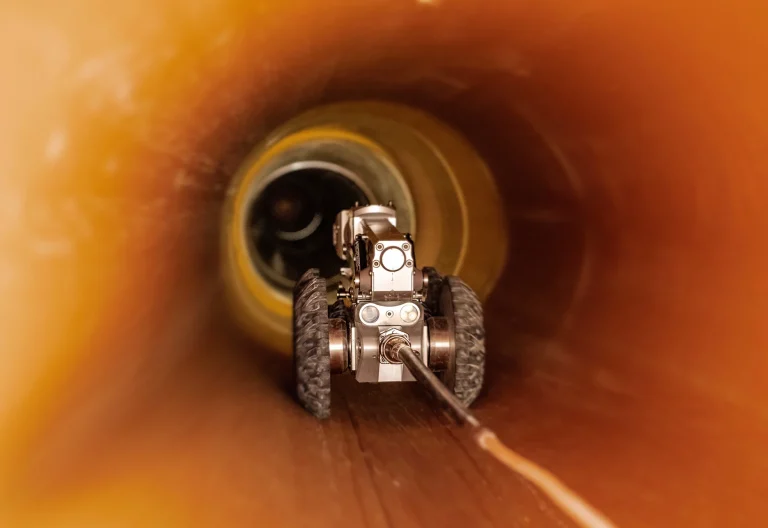
Deflection testing confirms that a flexible pipe has not deformed beyond the limits allowed for that pipe and project. A deflection gauge or ovality tester is drawn through the pipe between maintenance holes. If the pipe has squashed past the allowed limit, the tool will not pass, and the location is recorded.
Because deflection develops as backfill is placed and settles, the test is normally done after backfilling and compaction are complete, and is often paired with CCTV inspection so any problem spot can be seen as well as measured. For a short overview, see what is deflection testing.
How the two tests work together
Compaction testing is preventive: it makes sure the support around the pipe is right while the trench is still open. Deflection testing is the proof: it shows the pipe kept its shape once the ground was finished. A project that passes compaction tests but fails deflection points to an installation or bedding issue; a project that skips compaction testing often finds out at the deflection stage, when fixing it means digging up finished work.
Running both, along with pressure or air testing and CCTV, gives the asset owner a complete record at handover. See can multiple testing methods be used on the same project and is pipe testing required before asset handover.
What if a section fails?
Low compaction results usually mean the layer is reworked and re-tested before work continues. A deflection failure usually means the affected length is excavated, the pipe re-bedded or replaced, and the section tested again. In both cases the earlier the issue is found, the smaller the fix. Read what happens if a pipe fails testing for more.
Book compaction and deflection testing
J & J Pipe Testing provides NATA accredited compaction, DCP and deflection testing, Level 1 supervision and CCTV inspection for civil contractors, developers and councils across NSW. Request a quote or contact us to plan testing around your backfill program.