
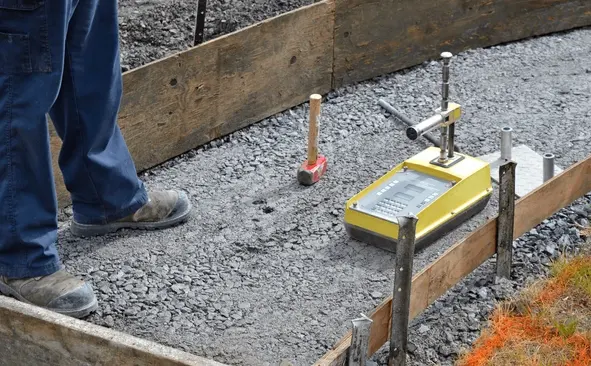
Certified backfill testing for structural and compliance assurance
Compaction testing ensures that soil materials placed around and above pipelines meet the required engineering standards. This verification is essential for long-term structural stability and is mandated under Section 73, Sydney Water technical specifications, and many local council approvals.
The process involves creating a ground test point by hammering a metal pin into the soil. A nuclear densometer is then used to measure in-situ dry density and moisture content. A soil sample is also collected for laboratory analysis. Field and lab results are compared to confirm a compaction percentage, typically 98 percent or higher.
Accurate compaction results help prevent future issues such as settlement, pipe movement, or structural failure. All results are documented in NATA-certified reports suitable for council and construction submission.
Our Process
- Establish a test point by driving a metal pin into the ground to create a stable measurement location
- Perform in-situ field testing using a calibrated nuclear densometer to assess dry density and moisture content
- Collect a representative soil sample from the test point for laboratory analysis, ensuring accurate material characterisation
- Compare laboratory and field results against WSA requirements or project-specific compaction criteria
- Prepare NATA-certified documentation, including test data and compaction percentages
Why It Matters
- Verifies structural stability around pipelines and foundations
- Prevents costly long-term issues, including subsidence, pipe movement, and surface deformation
- Ensures compliance with Section 73, Sydney Water, and council requirements, avoiding delays during inspections or handovers
- Provides an objective measurement of how well the soil has been compacted, rather than relying on visual assessment or assumptions
Why Choose Us
- Sydney Water Certified technicians with extensive field experience
- NATA-Accredited Reporting [Click here to view our accreditation.]
- Fast turnaround and clear, easy-to-read documentation
- Reliable accuracy, backed by calibrated equipment, traceable procedures, and strict quality controls


