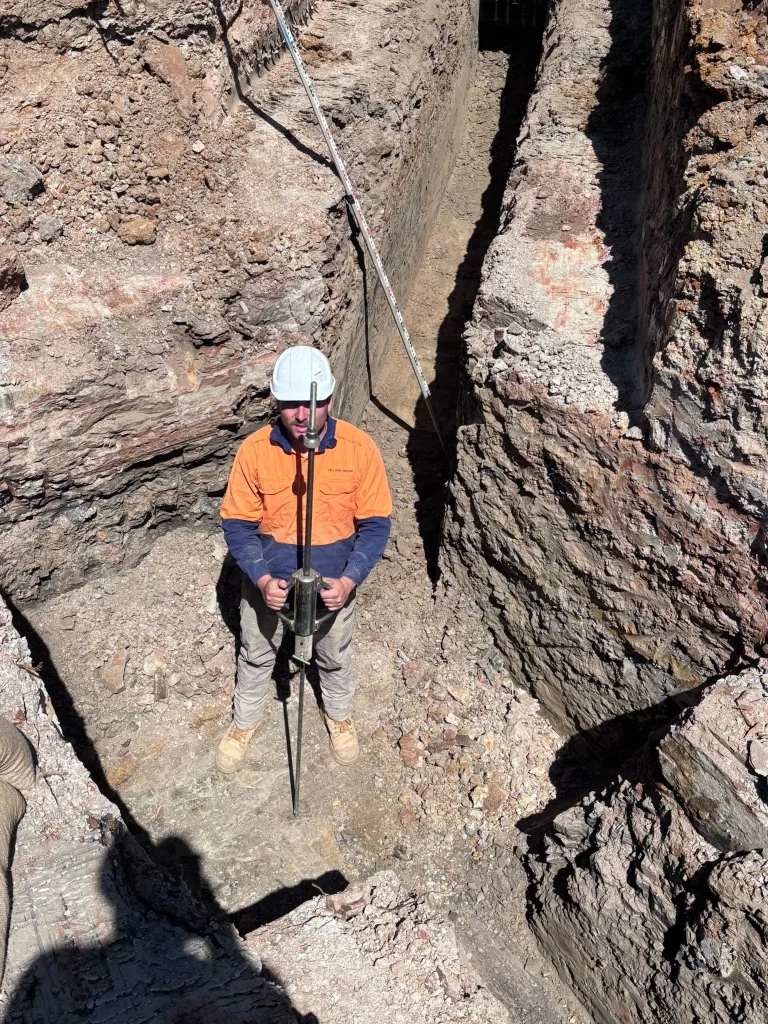
Soil strength testing beneath maintenance hole foundations
Dynamic Cone Penetrometer (DCP) testing is a geotechnical method used to assess the bearing capacity and density of soil layers beneath maintenance hole (manhole) foundations. It confirms ground stability before concrete bases are poured, for long-term durability and compliance with Sydney Water, Section 73 and council requirements.
How DCP testing works
A cone is driven into the soil with repeated hammer blows, and the depth of penetration is recorded after each blow. The rate of penetration, measured in millimetres per blow, shows the soil’s density and compaction at different depths and identifies weak or loose layers that may need remediation before construction.
Testing is carried out in situ below each maintenance hole location.
Where DCP testing applies
- Maintenance hole installations and upgrades
- New infrastructure and subdivision developments
- Sites requiring soil verification before concrete bases are poured
- Projects where long-term structural support is critical
Key benefits
- Assesses soil strength and compaction under maintenance hole foundations
- Identifies unstable layers that could compromise structural integrity
- Supports compliance with Sydney Water, Section 73 and council standards
- Provides reliable data for site preparation and foundation approval
What you receive
A NATA accredited report for each location tested, recording penetration per blow through the soil profile, so engineers can confirm foundation stability before the base is poured. You can view our accreditation on the NATA register.
DCP testing is often booked with compaction testing and Level 1 Supervision, and the finished structure is checked with vacuum testing.